
Your Posture Is Changing: The Hidden Story of Bone + Muscle Loss

Updated: Aug 26
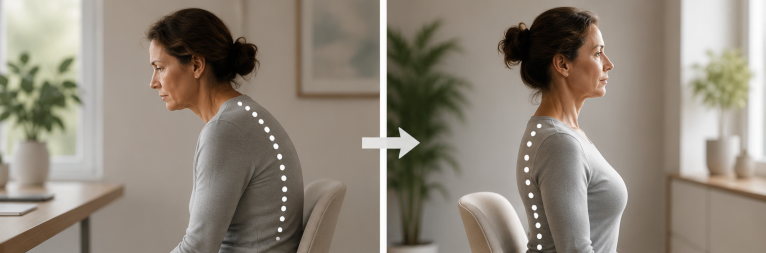
If you’ve noticed your shoulders rounding forward, your head drifting in front of your body, or your upper back looking slightly more curved than it used to, you’re not imagining it. Your posture really is changing, and it’s not just getting older.
Postural changes are usually the first visible signs of what’s happening underneath the surface: muscle loss, bone remodeling, changes in spine alignment, decreased core stability, and hormonal shifts affecting bone turnover.
None of this happens overnight. It’s gradual, predictable, and correctable when you understand the forces shaping your posture.
Why Posture Declines in Midlife
Muscle loss around the spine and shoulders: The deep spinal stabilizers, rear shoulders, lats, traps, and core naturally shrink with age unless you challenge them. Less muscle means less support and more rounding.
Bone loss in the spine and rib cage: As bone turnover becomes imbalanced, the structural support behind your posture weakens. Small shifts in density change how you stand and move.
Desk work and forward head position: Screens pull your head forward and tighten the front of your body. Your body adapts to the position it spends the most time in.
Hormone shifts affecting bone and muscle: Declines in estrogen, progesterone, and testosterone alter how quickly bone is rebuilt and how well muscles regenerate.
Bone is constantly being remodeled throughout life, and hormones strongly influence how quickly those remodeling systems work. If you want a deeper understanding of this physiology, you can read How Hormones Shape Bone Strength at Every Age.
Weak glutes and pelvic imbalance: When glutes weaken, the pelvis tilts forward or backward, shifting the entire spine.
Early Signs Your Posture Is Changing
Rounded shoulders
Forward head (“tech neck”)
Tightness across the chest
Upper or mid-back stiffness
A softer or flatter upper-back appearance
Feeling “compressed”
More effort required to stand upright

How Bone Loss Affects Posture
Bone loss doesn’t just result in fractures, it changes the architecture of your spine.
Bone loss often accelerates quietly for years before osteoporosis is ever diagnosed, which is why postural changes are sometimes one of the earliest visible clues. I discuss this process further in The Silent Decade: Why Bone Loss Accelerates Long Before Osteoporosis.
Weakened vertebrae, altered rib cage expansion, reduced shock absorption, and subtle changes in spinal stacking all contribute to postural shifts. Because bone and muscle age together, decreased bone strength usually shows up alongside decreased spinal muscle mass.
Many people assume posture changes are purely a bone issue, but muscle decline is often the earlier driver. If you’re noticing reduced strength, balance, or stability, learn how I take a structured approach to rebuilding muscle strategically.
Exercises to Improve Your Posture
These movements directly strengthen the muscles responsible for alignment and create mechanical load your bones respond to. Aim for 3–4 times per week.
Wall Angels: Stand against a wall and glide your arms up and down, keeping your back flat. Strengthens scapular muscles and opens the chest.
Prone W Lift: Lie face down and lift your arms in a W shape, squeezing shoulder blades. Builds mid‑back strength.
Dead Bug: Lower opposite arm and leg while keeping your back flat. Improves deep core stability.
Hip Hinge or Romanian Deadlift: Use dumbbells or a kettlebell. Strengthens glutes, hamstrings, and spinal stabilizers.
Chest-Opening Stretch: Use a doorway to stretch tight anterior muscles pulling you forward.
Row Variations: Any row variation strengthens the upper back and shoulder blade control.
Farmer’s Carry: Hold weights at your sides and walk. Builds spinal stability and grip strength. (One of my absolute favorite overall exercises for men and women!)
Glute Bridges or Hip Thrusts: Strengthen glutes to stabilize pelvic position.

What Works Best
Strengthening the posterior chain
Improving thoracic spine mobility
Building core stability
Balancing chest and back strength
Supporting a healthy bone turnover environment
If you’ve noticed shifts in posture, such as rounded shoulders, stiffness, or feeling more compressed, you’re not imagining it. Bone and muscle change with age, and this is the decade where early, intentional strengthening makes the biggest difference in how you look, move, and feel.
Posture changes are rarely isolated to the spine alone. They are usually connected to broader shifts in muscle, metabolism, hormones, recovery, and long term aging physiology. If you want a deeper understanding of how these systems interact, you can read The Complete Guide to Metabolic Health and Longevity.


Comments