
Menopause and Joint Pain: Why Do My Joints Hurt All of a Sudden?

You wake up in the morning and your knees feel stiff. Your hips ache after you've been sitting for a while. Your shoulder suddenly hurts even though you don't remember injuring it. Workouts that never bothered you before now leave you sore for days.
And you start wondering: Why does everything suddenly hurt?

If you're in your 40s or 50s, you may assume this is simply part of getting older. But if your joint pain or stiffness started around the same time as other symptoms of perimenopause or menopause, changing hormones may be part of the explanation.
Joint and muscle pain are surprisingly common during the menopause transition. Researchers are increasingly recognizing that declining estrogen can affect not just hot flashes, sleep and vaginal health, but your muscles, bones, tendons and joints as well.
That doesn't mean every aching joint is caused by menopause. But new joint pain during perimenopause or menopause deserves a more thoughtful explanation than simply being told you're getting older.
How Common Is Joint Pain During Menopause?
Much more common than you might think.
A recent systematic review and meta-analysis involving more than 93,000 women found muscle or joint pain in approximately 40% before menopause, 57% during perimenopause and 59% after menopause.
That doesn't prove estrogen loss is responsible for every case of joint pain. Your age, activity level, body composition, previous injuries and underlying medical conditions all matter.
But if you've noticed that you feel stiffer, achier or less resilient than you did just a few years ago, the timing of those symptoms in relation to menopause is worth considering.
What Does Estrogen Have to Do With Your Joints?
You probably think of estrogen primarily as a reproductive hormone. But estrogen receptors are found throughout your body, including in cartilage, bone, muscle, tendons, ligaments and other connective tissues.
As estrogen fluctuates during perimenopause and eventually declines after menopause, several things can change.
If you want to understand the broader effects of these hormonal changes, I explain them in my Complete Guide to Menopause & Hormone Optimization.
Estrogen plays a role in regulating inflammation and pain signaling. It also affects your muscle, bone and connective tissue. Changes in estrogen may therefore influence both how your joints feel and how well the tissues surrounding those joints function.
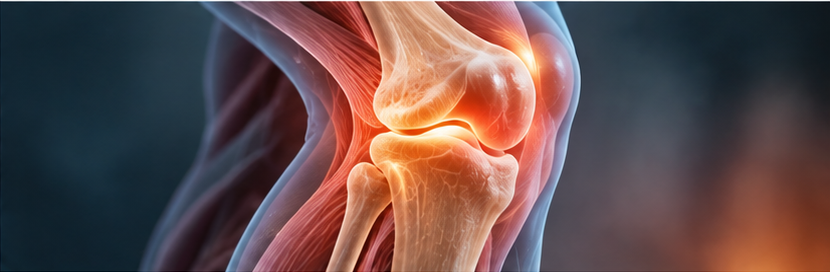
The pain you feel around a joint isn't necessarily coming only from the joint itself.
The strength of the muscles surrounding that joint, the health of your tendons and ligaments, your body composition and even how you move can influence how that joint feels.
What Is the Musculoskeletal Syndrome of Menopause?
In 2024, researchers proposed the term “musculoskeletal syndrome of menopause” to describe the collection of musculoskeletal changes that can occur as estrogen declines.
These changes can include:
Joint pain and stiffness
Loss of muscle mass and strength
Bone loss
Changes in tendons and ligaments
Increased risk of some musculoskeletal injuries
Changes associated with osteoarthritis
I think this is a useful way to look at what happens during menopause because your bones, muscles and joints don't function independently. They work together.
For example, if you lose strength in the muscles surrounding your hips or knees, those joints may not be supported as effectively. If you already have some osteoarthritis, losing muscle and changing how you move may make those joints more symptomatic.
That's why maintaining muscle becomes increasingly important as you move through menopause.
What Does Menopause Joint Pain Feel Like?
There isn't one specific pattern of menopause joint pain.
You might notice:
Morning joint stiffness that improves once you start moving
Aching knees, hips or shoulders
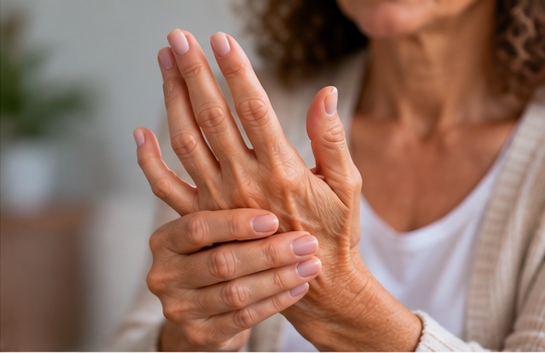
Stiff or uncomfortable hands
More discomfort when climbing stairs
Hip pain after sitting
New tendon pain
Increased soreness after exercise
A longer recovery time after workouts
Sometimes it's not one specific painful joint.
You may simply notice that your entire body feels stiffer or older than it did a few years ago, despite not having dramatically changed your activity.
If that change appeared around the same time as irregular periods, hot flashes, sleep disruption or other perimenopause symptoms, hormones deserve consideration as one piece of the puzzle.
Not Every Aching Joint Is Menopause
It's important not to swing too far in the other direction and blame every new symptom in your 40s or 50s on hormones.
Joint pain can also come from osteoarthritis, previous injuries, thyroid disorders, autoimmune or inflammatory conditions, certain nutritional deficiencies and other medical problems.
You should have persistent or unexplained joint pain evaluated, particularly if you have:
Significant swelling
A red or hot joint
Severe or rapidly worsening pain
Significant weakness
Fever
A new rash
Multiple swollen joints
Symptoms that aren't improving
Menopause may be contributing to your symptoms without being the entire explanation.
Can Hormone Therapy Help Menopause Joint Pain?
Possibly, but this is an area where the evidence still isn't definitive.
Some research suggests that menopausal hormone therapy may improve joint symptoms. Data from the Women's Health Initiative, for example, found a modest reduction in joint pain among women receiving estrogen compared with placebo.
Other studies have produced inconsistent results.
For that reason, I wouldn’t necessarily recommend starting hormone therapy solely because your joints hurt.
If you're an appropriate candidate for menopausal hormone therapy and you're also experiencing hot flashes, night sweats, sleep disruption, vaginal symptoms or other effects of estrogen loss, improvement in joint symptoms may be an additional benefit.
But hormone therapy isn't an arthritis treatment, and persistent joint pain still deserves an appropriate evaluation.

Muscle Loss Can Make Joint Pain Worse
When your knee or hip hurts, your instinct may be to move less.
That can create a frustrating cycle:
Joint pain → less activity → muscle loss → less support around the joint → greater difficulty moving
Your muscles provide dynamic support for your joints.
Your quadriceps help stabilize your knees. Your glutes help control your hips and pelvis. Your core muscles contribute to spinal and pelvic stability.
At the same time, maintaining muscle becomes more difficult with age and hormonal changes. This is one reason I consider preserving muscle during menopause such an important part of healthy aging.
That's why if you’re noticing joint pain, I don't think only about the painful joint. I also want to know what is happening to your muscle.
Have you lost strength? Have you stopped resistance training? Has your body composition changed? Are you avoiding activity because movement hurts?
Want to learn more about protecting and rebuilding muscle as you age? I created a short email series that explains why muscle becomes harder to maintain in midlife, what actually helps you build it, and why muscle matters for much more than appearance. Join my Muscle Health Email Series
Can Strengthening the Muscles Around Your Joints Help?
In many cases, yes.
Resistance training is one of the most important tools you have for maintaining muscle and physical function as you age. Adequate protein is also important, particularly if you're trying to lose weight at the same time.
Depending on what's causing your symptoms, physical therapy can help you strengthen specific muscle groups and improve movement patterns.
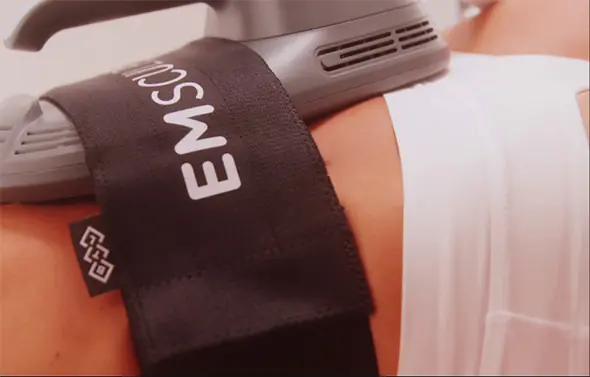
I also use Emsculpt Neo in a functional way in my practice when targeted muscle strengthening may be helpful.
You’ve heard me discuss Emsculpt Neo for body contouring, but its ability to create powerful muscle contractions also allows us to target specific muscle groups involved in movement and joint support.
This is not about treating the cartilage inside your joint. Instead, I'm interested in what happens when you strengthen the muscles responsible for supporting and controlling a painful or poorly functioning joint.
What Does the Research on Functional Emsculpt Neo Show?
Early research on use of this technology is encouraging.
In a 2025 study of 36 adults with musculoskeletal and joint problems, researchers used four 30-minute HIFEM treatments on muscles of the upper or lower extremities.
At three months, researchers reported an average 68% improvement in WOMAC scores, which is a validated measure that includes lower-extremity pain, stiffness and physical function.
They also reported a 68% improvement in DASH scores, which evaluate upper-extremity physical function and disability.
At the three-month follow-up:
97% reported that the treated joint felt better
91% reported increased range of motion
85% reported reduced discomfort
82% reported improved mobility
Another study examined people with impaired lower-extremity muscles. After treatment with HIFEM plus synchronized radiofrequency, the active-treatment group demonstrated an average 52% increase in measured muscle strength at three months.
I think of functional Emsculpt Neo as another potential way to address the muscle side of the joint-health equation. If weakness or poor muscle conditioning is contributing to how your joint functions, strengthening those muscles may help improve your strength, mobility and comfort.
It can work in conjunction with physical therapy and other modalities.
What Can You Do About Joint Pain During Perimenopause and Menopause?
It’s best to start by figuring out why you hurt rather than assuming menopause is the answer.
Have you lost muscle or strength? Has your activity level changed? Have you gained visceral fat or lost lean mass even though your weight hasn't changed very much?
Once we understand what's contributing, your treatment may include resistance training, adequate protein, improving body composition, correcting nutritional deficiencies, physical therapy, orthopedic or rheumatologic evaluation when appropriate, and treating menopause symptoms when hormone therapy makes sense for you.
Targeted muscle strengthening, including functional Emsculpt Neo, may also have a role for selected people.
The important part is not to stop moving simply because you're hurting. If pain causes you to become increasingly sedentary, losing additional muscle can make maintaining your strength and function even harder.
Your Joints Didn't Necessarily “Just Get Old”
If you've reached your 40s or 50s and suddenly feel like your joints have aged faster than the rest of you, don't automatically dismiss it as normal aging.
Your menopause transition may be contributing.
That doesn't mean estrogen explains every painful joint or that hormone therapy is automatically the answer. Your hormones, muscle mass, bone health, inflammation, body composition and joint mechanics can all intersect.
This is why I look at these issues together rather than treating each symptom in isolation.
At Foundations at Maitland in Orlando, I evaluate midlife health through that broader lens. If you're experiencing new joint pain or stiffness along with changes in your hormones, strength or body composition, we can look at what's actually contributing and determine which interventions make sense for you.

Frequently Asked Questions About Menopause and Joint Pain
Can perimenopause cause joint pain?
Joint and muscle pain become more common during perimenopause. Fluctuating and declining estrogen may contribute through effects on inflammation, pain signaling, muscle and connective tissue. However, other causes of joint pain should still be considered.
What does menopause joint pain feel like?
You may experience morning stiffness, aching knees or hips, shoulder pain, hand stiffness, tendon discomfort or increased soreness after exercise. Some women describe a more generalized feeling of stiffness rather than pain in one specific joint.
Does low estrogen cause joint pain?
Low or fluctuating estrogen appears to be one contributor to musculoskeletal symptoms during menopause, but the relationship is complex. Aging, muscle loss, osteoarthritis, inflammation, previous injuries and body composition can also affect joint symptoms.
Will HRT help joint pain during menopause?
It may help some women. Research has found modest improvements in joint symptoms with hormone therapy in some studies, but the evidence isn't consistent enough to use HRT specifically as a treatment for arthritis or chronic joint pain.
Does Emsculpt Neo help joint pain?
Emsculpt Neo does not treat arthritis or repair damaged cartilage. Functional treatment targets the muscles involved in movement and joint support. Early studies have reported improvements in strength, mobility, range of motion, discomfort and validated measures of physical function, but larger independent studies are still needed.
Is exercise good for menopause joint pain?
Appropriate movement and resistance training are generally important for maintaining muscle strength and joint function. However, significant swelling, acute injury, severe pain or unexplained weakness should be evaluated before you simply try to exercise through the symptoms.
___________________________________________________________________
Struggling with declining strength or slower metabolism?
Explore our structured muscle preservation approach. foundationsfl.com/contact?source=muscle_series
Listen to Dr Jackson discuss these topics on her podcast, Ageless and Outrageous agelessandoutrageous.alitu.com
Foundations at Maitland offers physician-led hormone optimization and longevity care.


Comments