

Is 65 Too Late for Your First DEXA Scan?

If you’re a woman in your 40s or 50s, you’re probably hearing a lot about protecting your heart, maintaining muscle, managing your weight, and navigating the hormonal changes of menopause.
But there’s another major change happening inside your body that you can’t see or feel.
You may be losing bone.
And this is something about menopause medicine that has never made complete sense to me: Why do we routinely wait until age 65 to start looking?
The U.S. Preventive Services Task Force recommends osteoporosis screening for all women beginning at age 65. ACOG similarly recommends bone mineral density testing at 65. Both recommend earlier screening for certain postmenopausal women who are at increased risk of fracture.¹˒²
Those recommendations are designed primarily around identifying women at sufficient fracture risk to benefit from screening and treatment.
But here’s the question I want to answer:
If we’re interested in prevention, should we be looking at bone density before much of the loss has already occurred?

Your Bones Have a Life Cycle
We tend to think of our skeleton as a permanent framework that simply becomes more fragile as we get older.
Bone is much more dynamic than that.
Your bones are living tissue that is continuously being remodeled. Cells called osteoclasts remove older bone, while osteoblasts build new bone.
Your bone life cycle looks something like this:
Childhood and adolescence: Bone formation exceeds breakdown as you build your skeleton.
20s: You reach or approach your peak bone mass.
30s and 40s: The emphasis increasingly shifts toward maintaining the bone you built.
Menopause transition: Declining estrogen accelerates bone breakdown.
Postmenopause: Preserving bone becomes increasingly important as cumulative loss continues.
Peak bone mass is generally reached in young adulthood, often between about ages 18 and 25, although skeletal development and consolidation can continue into the 20s.³
Does that worry you? It worries me! I am well past the time of peak bone mass, as you may be as well. Then it is so important to think about preserving or increasing our bone mass now.

Menopause Changes the Math
Estrogen plays an important role in regulating bone remodeling.
As estrogen declines during the menopause transition, bone resorption increases. The osteoclasts breaking down bone begin to outpace the osteoblasts trying to replace it.
This is why the years surrounding menopause are so important for skeletal health.
The Bone Health & Osteoporosis Foundation reports that women can lose up to 20% of their bone density during the five to seven years following menopause, although the amount and rate of loss vary considerably from woman to woman.³˒⁴
And here’s what makes this particularly concerning:
You don’t feel it happening.
Your hip doesn’t hurt because your bone density dropped. Your spine doesn’t send you a warning that your skeletal reserve is declining.
For many women, bone loss remains completely silent until it is identified on imaging or, much later, contributes to a fracture.
Estrogen helps regulate bone remodeling, so the hormonal changes of menopause matter to skeletal health.
So Why Do We Wait Until 65?
To be clear, guidelines don’t say every woman should wait until 65.
Earlier DEXA screening is recommended for certain postmenopausal women based on fracture risk factors such as low body weight, parental history of hip fracture, smoking, and excess alcohol use.¹
That makes sense when we’re asking: Who is at enough risk for fracture that we should screen earlier?
But prevention makes me ask a different question: What if I want to know where your bones are starting before menopause has had years to affect them?
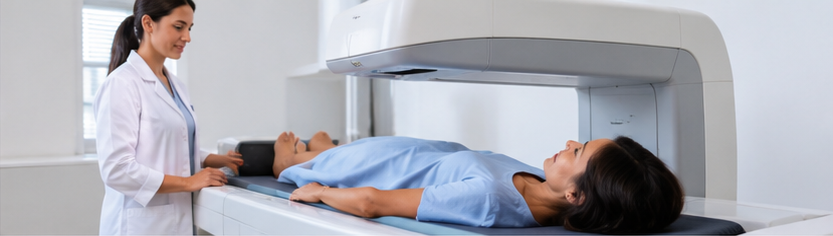
Your First DEXA at 65 Isn’t Really Your Baseline
Imagine a healthy woman goes through menopause at 51.
She doesn’t have the traditional risk factors that trigger earlier screening, so she has her first DEXA at 65.
Maybe it’s normal. Maybe it shows osteopenia. Maybe it shows osteoporosis.
Whatever the result, we now know what her bone density is at 65.
But we don’t know:
What her bone density was before menopause
How much bone she lost during the menopause transition
Whether she lost bone rapidly or gradually
When that loss occurred
I sometimes describe it this way: That isn’t really your baseline DEXA. That’s your bone-loss DEXA.
We’re measuring your bones after they have already traveled through one of the most important periods of skeletal change in a woman’s adult life.
What Would an Earlier Baseline Tell Us?
A DEXA is not a perfect test.
It measures bone mineral density. It does not directly measure every component of bone strength, including bone microarchitecture and collagen quality. And a single scan cannot tell us how quickly someone is losing bone.
But an earlier measurement can give us something we otherwise don’t have: A reference point.
If an appropriate future DEXA is compared with that baseline, we can begin to understand the direction of change rather than simply asking whether you’ve crossed the diagnostic threshold for osteopenia or osteoporosis.
That distinction matters to me.
I don’t only want to know whether you have osteoporosis. I want to know whether you’re heading toward it.

Protecting Your Bones Means Looking Beyond the Scan
Getting a baseline measurement doesn’t protect your bones by itself.
What happens during these years matters:
Hormones: Estrogen helps regulate bone remodeling, so the hormonal changes of menopause matter to skeletal health.
Muscle: Strong muscles create forces on bone that help stimulate adaptation.
Resistance + impact: Walking is excellent for cardiovascular and metabolic health, but bone also needs adequate mechanical load from resistance training and appropriate weight-bearing or impact activity.
Protein + nutrition: Bone needs adequate protein, calcium, vitamin D, magnesium, and sufficient overall nutrition.
Lifestyle + medical factors: Smoking, excess alcohol, certain medications, and some medical conditions can accelerate bone loss.
Calcium and vitamin D matter. But supplements alone aren’t a bone-health strategy.
Your bones need the raw materials, but they also need the hormonal signals and mechanical stimulus telling them what to do with those materials.
Strong muscles create forces on bone that help stimulate adaptation. If you want to learn how to preserve and build muscle as you age, join my free Muscle Education Series.
Some Women Absolutely Should Be Evaluated Earlier
Even under current screening recommendations, 65 is not the appropriate starting point for every woman.
Earlier assessment may be appropriate based on factors such as:
Low body weight
Previous fracture
Parental history of hip fracture
Cigarette smoking
Excess alcohol intake
Medications associated with bone loss, including long-term glucocorticoid use
Medical conditions associated with low bone mass or accelerated bone loss¹˒⁵
So if you’re younger than 65, don’t interpret the routine screening age as meaning that you don’t need to screen yet; this may be flawed reasoning.
Bone health is only one part of healthy aging. Muscle, hormones, metabolism, sleep, and inflammation all influence how we function over time. Read my Complete Guide to Metabolic Health & Longevity to see how these systems fit together.

I Don’t Want to Wait for Bone Loss to Become a Diagnosis
I understand why population-level screening guidelines focus heavily on fracture prevention. Advancing age itself increases fracture risk, and the evidence behind screening recommendations focuses on whether screening ultimately reduces osteoporotic fractures.¹˒⁶
But my approach to menopause and longevity is also about identifying changes while we still have an opportunity to influence the trajectory.
We know women reach peak bone mass relatively early in life.
We know estrogen declines during menopause.
We know bone loss can accelerate during the years surrounding menopause.
And we know women usually cannot feel that loss occurring.
That’s why I believe the conversation about bone density should begin well before 65.
For some women, that may include discussing whether an earlier baseline DEXA makes sense based on their individual history, menopause status, and risk factors.
I don’t want our first conversation about your bone health to happen after you’ve already lost a significant amount of bone. I want us thinking about how to preserve it while you still have it.
References
U.S. Preventive Services Task Force. Osteoporosis to Prevent Fractures: Screening. Final Recommendation Statement. January 14, 2025. USPSTF recommendation
American College of Obstetricians and Gynecologists. Osteoporosis. ACOG Women’s Health FAQ. ACOG osteoporosis guidance
Bone Health & Osteoporosis Foundation. Bone Basics. Bone Health & Osteoporosis Foundation: Bone Basics
Bone Health & Osteoporosis Foundation. What Women Need to Know. Bone Health & Osteoporosis Foundation: What Women Need to Know
International Society for Clinical Densitometry. 2023 ISCD Official Adult Positions: Indications for Bone Mineral Density Testing. ISCD Official Adult Positions
U.S. Preventive Services Task Force. Evidence Summary: Osteoporosis to Prevent Fractures: Screening. 2025. USPSTF evidence summary
Frequently Asked Questions About DEXA Scans and Menopause
At what age should a woman get a DEXA scan?
Current guidelines recommend routine osteoporosis screening with bone-density testing for women beginning at age 65. Postmenopausal women younger than 65 may need earlier screening based on their individual risk factors for osteoporosis and fracture.
Should I get a DEXA scan during menopause?
Not every woman needs a DEXA during menopause under current screening guidelines. However, menopause is an important time to discuss bone health because declining estrogen can accelerate bone loss. Women with additional risk factors may benefit from earlier bone-density testing.
Does menopause cause bone loss?
Menopause can accelerate bone loss because declining estrogen changes the balance between bone breakdown and bone formation. Bone loss can be particularly significant during the menopause transition and early postmenopausal years.
What is the difference between a DEXA scan and a bone density test?
They generally refer to the same test. A DEXA, also called DXA or dual-energy X-ray absorptiometry, is the standard test used to measure bone mineral density and help assess osteoporosis and fracture risk.
Can you have bone loss without symptoms?
Yes. Osteoporosis is often called a silent disease because declining bone density typically causes no symptoms. Many women do not know they have significant bone loss until it is found on a DEXA scan or a fracture occurs.
How can women protect bone density during menopause?
Bone-health strategies include resistance and weight-bearing exercise, maintaining muscle, adequate protein and overall nutrition, sufficient calcium and vitamin D, avoiding smoking and excessive alcohol, and addressing medical or hormonal factors that may contribute to bone loss.
Listen to Dr Jackson discuss these topics on her podcast, Ageless and Outrageous agelessandoutrageous.alitu.com
Foundations at Maitland offers physician-led hormone optimization and longevity care.

Comments